
Introduction
Walk onto any commercial job site and you'll hear "synthetic stucco" and "EIFS" used as if they mean the same thing. Sometimes they do. Sometimes they don't.
The confusion isn't harmless. According to EIMA, the EIFS Industry Members Association, EIFS is a layered, non-load-bearing wall cladding system built around insulation board, a reinforced base coat, and a finish coat — not a single product.
"Synthetic stucco" can mean that whole system, or it can mean just the acrylic finish sitting on top of it.
For general contractors, architects, developers, and property managers, that distinction affects insulation performance, moisture control, code compliance, and long-term maintenance costs.
This article breaks down the terminology, compares the systems side by side, and gives you a practical framework for choosing between them.
Key Takeaways
- "Synthetic stucco" often refers to EIFS, but it can also mean just the acrylic finish coat.
- EIFS is a full assembly: barrier, insulation, mesh, base coat, and finish coat.
- The right system depends on insulation goals, moisture exposure, and substrate condition.
- Installation quality matters more than the label on the spec sheet.
- Always have a qualified exterior wall contractor review the assembly before bidding.
Synthetic Stucco vs. EIFS: Quick Comparison
Before comparing performance, get the definition straight. Synthetic stucco is commonly a nickname for EIFS. Sto Corp, a major manufacturer, treats EIFS as its own product line and lists hard-coat stucco and cement-board stucco as separate systems.
The same term can also mean only the acrylic finish coat. That distinction matters as soon as you start comparing bids.
Cost
Pricing swings widely based on:
- Project size and substrate condition
- Insulation thickness and drainage requirements
- Detailing complexity around openings and transitions
- Site access and regional labor rates
- Whether the quote covers the finish only or the full installed system
No single national per-square-foot commercial price applies; costs are too project-specific. Ask any estimator to break the quote into materials, labor, prep, and system components before comparing bids.
Composition
Synthetic stucco/acrylic finish: A polymer-modified topcoat available in a wide range of textures and colors. It's the visible layer, not the wall assembly.
EIFS: The complete system: substrate, air and water-resistive barrier, drainage plane where specified, continuous insulation, reinforcing mesh, base coat, and finish coat.
Insulation and Energy Performance
EIFS can deliver continuous exterior insulation when designed and installed as a tested assembly, cutting thermal bridging. Dryvit's Type I EPS insulation board, for example, carries a minimum R-value of R-3.60 per inch at 75°F.
That figure is a board rating, not a whole-wall performance guarantee. A finish labeled "synthetic stucco" does not deliver that benefit unless the insulation type, thickness, and continuity behind it match a compliant design.

Moisture Management
Older barrier-style EIFS relied on the base coat alone as the weatherproofing line, backed up by sealants and flashings. Modern drainable EIFS adds a water-resistive barrier behind the insulation plus a path for incidental water to escape.
The 2024 International Building Code requires EIFS with drainage on Type V framed walls in specific residential occupancy groups, tested to a minimum 90% drainage efficiency. That is a specific code trigger, not a blanket rule for every commercial wall, so check your project's classification.
No finish name or clean surface appearance proves a wall is watertight. The assembly and installation details do.
Durability, Impact Resistance, and Maintenance
Reinforcing mesh embedded in the base coat is the main line of defense against impact damage. EIMA's ASTM E2486 testing framework breaks impact resistance into four categories:
| Category | Impact Energy |
|---|---|
| Standard | 25–49 inch-lb |
| Medium | 50–89 inch-lb |
| High | 90–150 inch-lb |
| Ultra High | Over 150 inch-lb |
Maintenance tasks look similar across systems: periodic cleaning, sealant checks, prompt repair of punctures, and recoating as the finish ages.
Installation Complexity and Project Fit
EIFS requires coordinated sequencing and system-compatible components from start to finish. "Synthetic stucco" as a term might only describe the finish coat, applied over any number of substrates. Evaluate the complete wall design, not just the appearance or the lowest bid.
What Is Synthetic Stucco and How Does It Relate to EIFS?
Synthetic stucco is a polymer- or acrylic-based finish engineered to mimic traditional stucco's texture while offering more flexibility, color range, and crack resistance than a cementitious coating alone. Confusion starts when manufacturers, inspectors, and property owners use "synthetic stucco" as shorthand for the entire EIFS assembly.
The EIFS Layer Sequence
A typical EIFS assembly, built outward from the structure, includes:
- Substrate or exterior sheathing — the structural base
- Air and water-resistive barrier — the first moisture defense line
- Drainage plane or cavity — where the system design requires it
- Continuous insulation — EPS, XPS, or mineral wool, depending on the tested assembly
- Reinforcing mesh embedded in base coat — the impact and crack resistance layer
- Textured acrylic finish coat — the visible, weather-exposed surface
Benefits and Trade-offs for Commercial Buildings
EIFS offers continuous insulation, reduced thermal bridging, lightweight construction, and broad design flexibility. It can mimic almost any architectural style in custom colors and textures without the weight of masonry.
The trade-off: performance depends entirely on compatible components and correct execution. Risk factors include:
- Incompatible or mixed manufacturer products
- Poor detailing at openings and transitions
- Inadequate drainage or sealant failure
- Substrate problems hidden behind the finish
- Weak field quality control during installation
Common Commercial Applications
EIFS shows up across hospitals, hotels, schools, offices, retail buildings, apartments, and assisted living facilities. It appears in renovation and retrofit work as often as new construction.
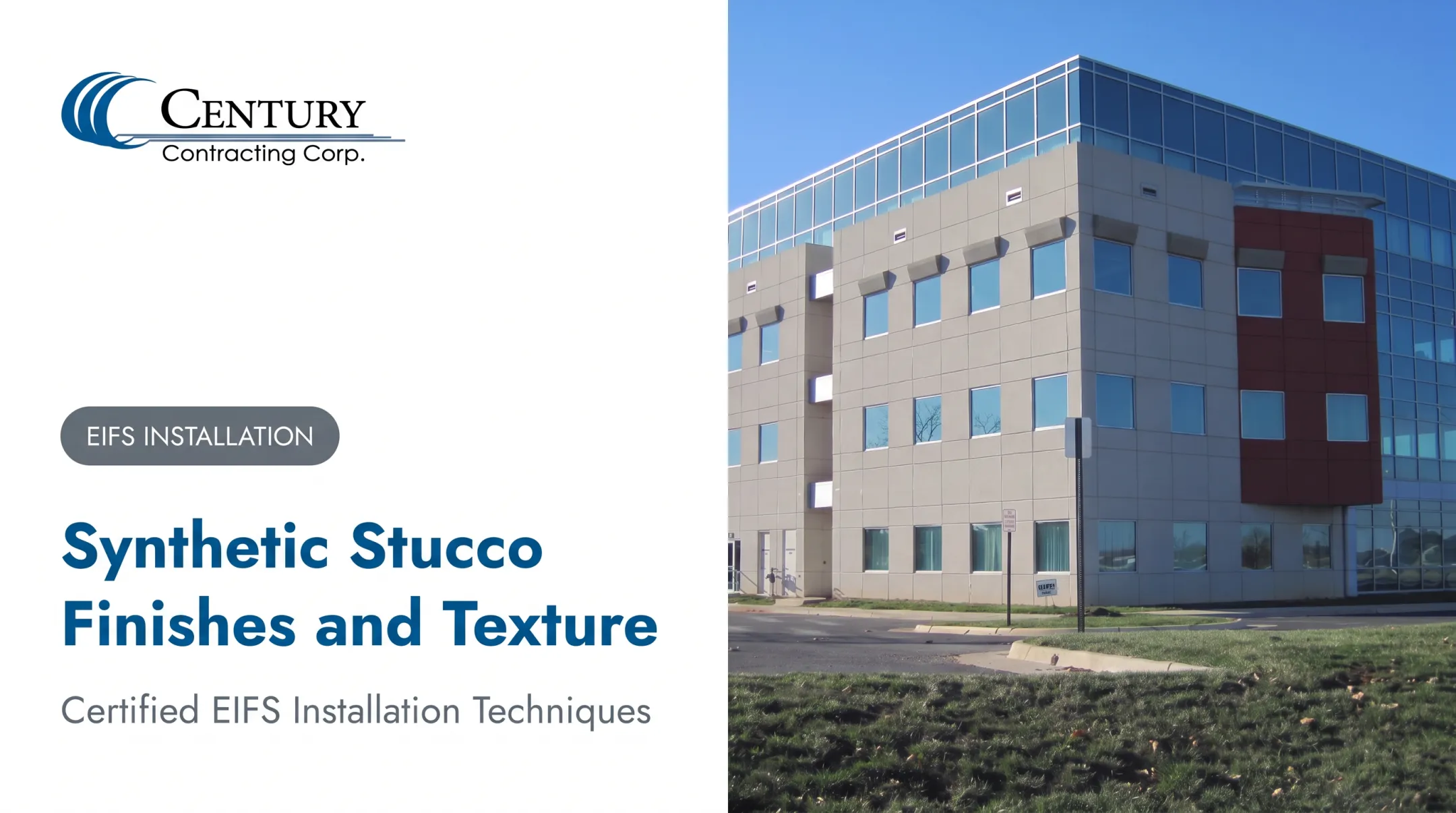
Century Contracting Corporation, a Lorton, Virginia-based exterior wall contractor operating since 1994, has installed EIFS on hospitality projects including Embassy Suites and Hampton Inn locations, healthcare facilities like Sinai Hospital, and educational buildings such as Carlos Rosario School.
Installation, Moisture Management, and Maintenance
Getting EIFS right isn't about any single layer. It's about sequencing—and about managing water and upkeep the same way you manage the finish.
The Application Process
A properly installed EIFS assembly moves through these stages:
- Substrate preparation and inspection
- Barrier installation (air and water-resistive membrane)
- Insulation board attachment
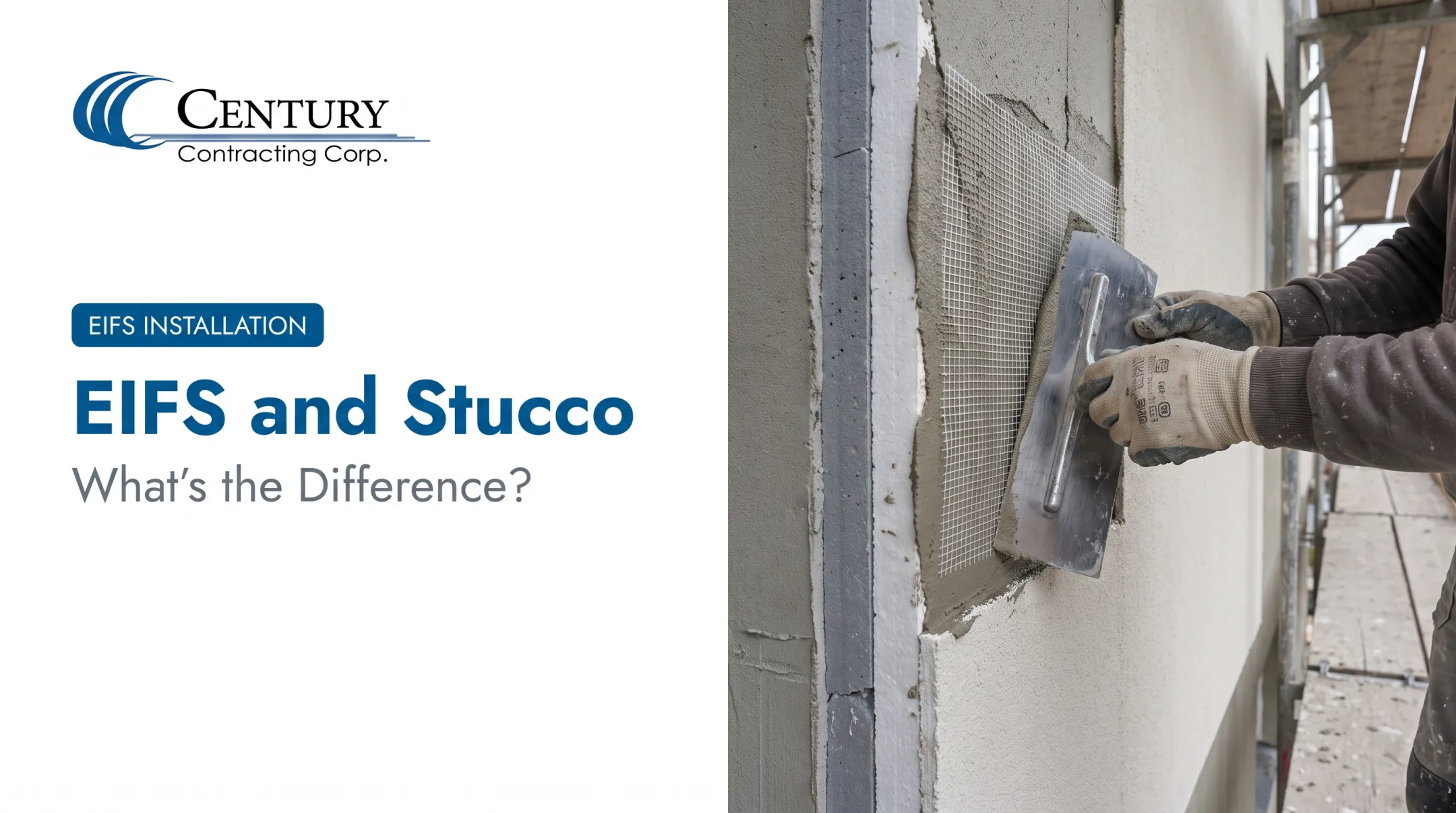
- Reinforcing mesh embedded in base coat
- Finish coat application
- Sealant and flashing installation at terminations
- Final inspection
Details That Deserve Extra Attention
Most EIFS failures trace back to a handful of trouble spots:
- Window and door openings
- Roof-to-wall intersections and parapets
- Penetrations for vents, pipes, or fixtures
- Deck and balcony transitions
- Joints between dissimilar materials
- Wall bases and drainage outlets
Mixing unapproved products at these details voids warranties and invites moisture problems. Keep the manufacturer's installation instructions, evaluation reports, submittals, and inspection records in the project file so any issue can be traced to the detail that caused it.
Moisture Management in the Assembly
Modern EIFS is built as a drainage-plane system, not a face-sealed skin. The water-resistive barrier behind the insulation, combined with flashing and sealant at openings, gives incidental moisture a path out instead of a path into the sheathing.
That only works when the WRB is continuous, drainage planes are not blocked, and terminations are detailed before the finish coat goes on. Skip or reverse those steps, and the same wall that looks fine at punch list can trap water for years.

A Practical Maintenance Plan
Owners and property managers should build in:
- Periodic visual inspections of the façade
- Cleaning using manufacturer-approved methods only
- Prompt repair of punctures or impact damage
- Sealant condition checks at joints and penetrations
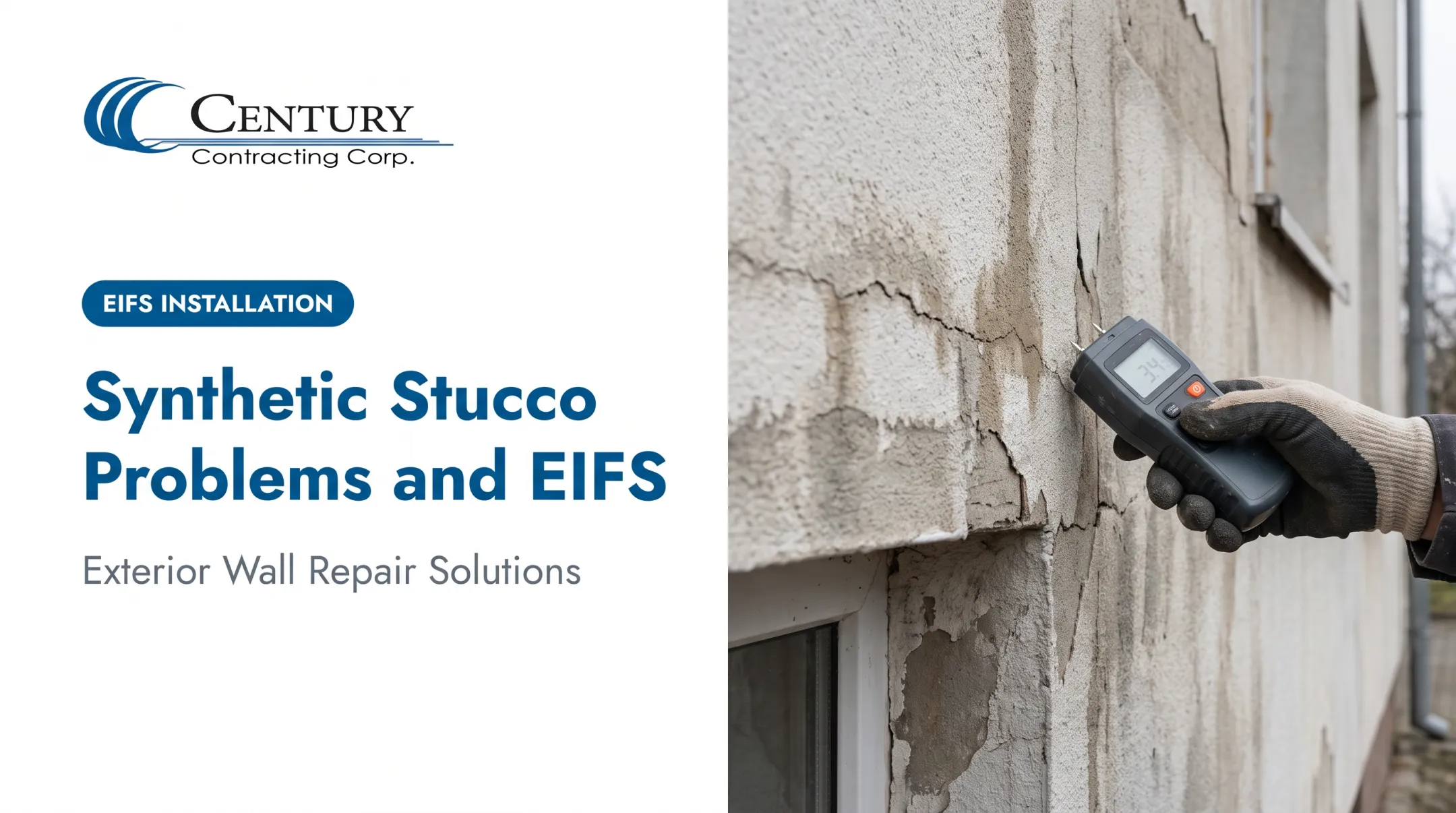
- Immediate investigation of staining, cracking, bulging, or interior moisture signs
Hand repairs and façade investigations to crews experienced with EIFS assemblies and manufacturer-approved details—especially when staining or leaks suggest concealed sheathing or framing damage behind the finish. Certified applicators are better positioned to protect both the warranty and the wall.
Synthetic Stucco vs. EIFS: What Is Better for a Project?
There's no universal winner here. The right answer depends on what the project actually needs.
Choose a Complete EIFS Assembly When:
- Continuous exterior insulation and thermal-bridging control are design priorities
- The project benefits from a lightweight facade with extensive texture, color, or architectural-shape flexibility
- The team can coordinate a tested system, a qualified applicator, and proper flashing, drainage, and sealant details
Choose a Stucco-Style Finish or Alternative Assembly When:
- The wall design, substrate, or code requirements favor a different stucco construction method
- The project needs a specific cementitious appearance, impact approach, or repair strategy
- Matching an existing finish matters more than introducing a new insulated system
Compare total cost of ownership, not just bid price. Factor in:
- Substrate repairs and access costs
- Insulation goals and cleaning needs
- Sealant replacement cycles and future repairs
- Warranty terms and occupant disruption during work
Commercial Selection Checklist
Before specifying either system, confirm:
- Substrate type, condition, and drainage path
- Climate, moisture exposure, and insulation targets
- Fire, code, and impact-resistance requirements
- Design and architectural finish requirements
- Schedule, maintenance access, and occupant constraints
- Warranty terms plus installer certifications and track record
That last point matters more than most teams give it credit for. Century Contracting Corporation is a Class A licensed commercial exterior wall contractor with an AWCI EIFSmart-certified workforce, EIMA membership, and certified or approved applicator status with Dryvit, STO, Senergy, and Parex.
If your team needs a project-specific estimate or scope review for EIFS, stucco, or related exterior wall repair work in the Mid-Atlantic region, request it before bids go out.
Real-World Project Examples and Selection Lessons
Two documented cases show how project constraints, not brand names, drive the right choice.
Waco Family Medicine, Waco, Texas. EIMA's case study on this 25,000-square-foot healthcare expansion describes a team facing a strict budget alongside a design goal for a wood-look exterior. They paired EIFS with prefabricated resin-cast wood plank accents rather than sourcing real wood cladding. The combined solution saved the project more than $400,000 compared to the original design approach. That outcome came from the whole facade strategy, not EIFS pricing alone.
Deseret Peak High School, Tooele, Utah. Dryvit's case study on this new educational building notes the architect selected EIFS specifically for continuous insulation, durability, and design flexibility across a 336,020-square-foot facility. The decision trigger here was performance and long-term maintenance planning for a public building, not appearance alone.

Century Contracting's own portfolio reflects the same pattern:
- Brick-and-stucco work at Wegmans retail locations
- EIFS installations for Disney MGM Studios
- Projects for the US Army Material Command
Across more than 3,000 completed projects and over one million square feet of EIFS, stucco, stone, and wall panel installations annually, the rule holds: choose the assembly to fit the substrate, budget, and performance target—not the other way around.
Before bidding or breaking ground, have the proposed assembly, details, and substrate reviewed by someone who installs this work daily.
Conclusion
Synthetic stucco and EIFS are closely related, but not interchangeable terms. Before comparing options, figure out whether you're evaluating an acrylic finish or a complete, multi-layer wall assembly — that single distinction shapes every decision that follows.
Insulation goals, moisture management, substrate condition, code requirements, detailing, and installer qualifications should drive your selection far more than appearance or the lowest number on a bid sheet.
Century Contracting Corporation has spent over 30 years installing EIFS and stucco assemblies across the Mid-Atlantic, from small repairs to large commercial new construction. If your team is planning a specification review, repair, or retrofit, reach out for a project-specific scope discussion before the work is locked in.
Frequently Asked Questions
How much does synthetic stucco cost per square foot?
Cost depends on region, project scale, substrate prep, insulation, drainage, detailing, and access. Ask whether a quote covers only the finish coat or the full EIFS assembly, and request a project-specific estimate.
How is synthetic stucco applied?
Installation involves preparing the substrate, installing the specified barrier and insulation layers, embedding reinforcing mesh in the base coat, applying the finish coat, and completing flashings, sealants, and drainage details.
How long will synthetic stucco last?
Service life depends on system design, exposure, workmanship, and maintenance. Manufacturers recommend annual inspections and prompt sealant repair rather than promising a fixed lifespan. Check manufacturer documentation for specifics.
Is synthetic stucco better than regular stucco?
Neither is universally better. EIFS suits projects prioritizing continuous insulation and design flexibility; traditional stucco may better fit substrate, budget, impact, or code requirements on other projects.
What is the best stucco for exterior walls?
It depends on the wall assembly, climate, moisture exposure, insulation needs, substrate, and code requirements. Compare full tested systems and qualified installers rather than judging finishes alone.
How do I know if I have synthetic stucco?
Appearance alone won't tell you. Review construction records, check for insulation and drainage layers behind the finish, and arrange a professional facade inspection if documentation isn't available.