
This guide is for commercial property owners, property managers, general contractors, developers, and architects. It covers how to diagnose damage, which repair options exist, what a professional process looks like, what drives cost, and how to vet a contractor.
Good Sto EIFS repair depends on system-compatible materials, installation that follows manufacturer guidance, careful moisture management, and a scope based on the whole affected wall area, not just the stain you can see.
Key Takeaways
- Repair the source and extent of damage, not just the visible crack or discoloration.
- Fix water intrusion, failed sealants, poor flashing, and incompatible patches before they damage the substrate.
- Use Sto-approved or system-compatible materials and follow current Sto guidance.
- Compare contractor credentials, scope, warranty terms, and cost drivers before approving work.
Understanding Sto EIFS and What Repair Services Cover
What Sto EIFS Is
EIFS is a multi-layer cladding system. The EIMA definition describes non-load-bearing cladding made of insulation, a reinforced base coat, and a textured protective finish. Depending on the assembly, the wall also includes adhesive, glass-fiber mesh, a water-resistive barrier, flashing, drainage components, and sealants.
Sto's StoTherm ci, for example, is a drainage EIFS that incorporates StoGuard beneath the insulation and finish.
EIFS is not cement-based stucco. Cement stucco is a hard, inorganic cladding. EIFS is an insulated, layered assembly in which every component has to work with the others. Treating the finish as an isolated coating is how repairs fail.
When Repair Is Appropriate
Repair usually fits these situations:
- Localized impact damage or punctures
- Cracks and failed sealant joints
- Finish deterioration
- Small areas of delamination
- Limited moisture damage found during assessment
The scope depends on whether the defect is isolated or tied to flashing, drainage, substrate deterioration, or repeated water entry.
Why Sto-Specific Expertise Matters
A repair starts with identifying the existing system. Insulation adhesive, mesh, base coat, finish, texture, color, and sealant all need to be compatible. Unverified substitutions between manufacturers invite adhesion problems.
Sto's technical literature is the right reference, not generic EIFS rules. Requirements differ by product and change with revisions, so confirm current documents for your assembly.
Common Sto EIFS Problems and Warning Signs
Moisture Intrusion and Hidden Substrate Damage
Water gets in around windows, doors, roof transitions, penetrations, joints, and damaged finishes. Building Science Corporation identifies window interfaces, joints, service penetrations, interfaces with other cladding, and large cracks as common entry paths.
Watch for:
- Staining, bubbling, blistering, or bulging
- Soft areas
- Mold or mildew growth
- Peeling finish
- Rust-colored marks
- Interior water stains or recurring dampness
Cracking, Impact Damage, and Delamination
Cracks range from hairline to wide. Other signs include punctures, dents, exposed mesh, detached insulation, hollow-sounding areas, and finish separation. Causes include building movement, impact, poor installation, and weather.
A patch fails when the damaged area isn't cut back to sound material or when the cause of the cracking is still there. Sto's repair guidance notes that punctures and cracks are intrusion vulnerabilities, and that opening the damaged area lets crews examine the substrate and water-resistive barrier.
Sealant, Flashing, and Transition Failures
Trouble concentrates where EIFS meets windows, doors, roofs, parapets, decks, masonry, metal panels, or other cladding. A failed sealant or poorly installed flashing can let water in even when the main wall field looks perfect.
EIMA bulletin 003 advises verifying sealant compatibility with both manufacturers and not bonding directly to the EIFS finish unless its manufacturer says so.
Cleaning-Related Damage
Aggressive cleaning erodes finish, opens joints, and can drive water into weak spots. Sto's RC100 cleaning specification (December 2023) calls for testing an inconspicuous area first and using the least aggressive effective method. It specifies a minimum 30-degree fan tip and a 500 psi maximum on EIFS. Always confirm the current version for your assembly.
Why a Visual Check Isn't Enough
The visible stain rarely marks the real repair boundary. A preliminary visual review can flag problems, but a full assessment may need to look at moisture conditions, substrate integrity, drainage details, and prior repairs.
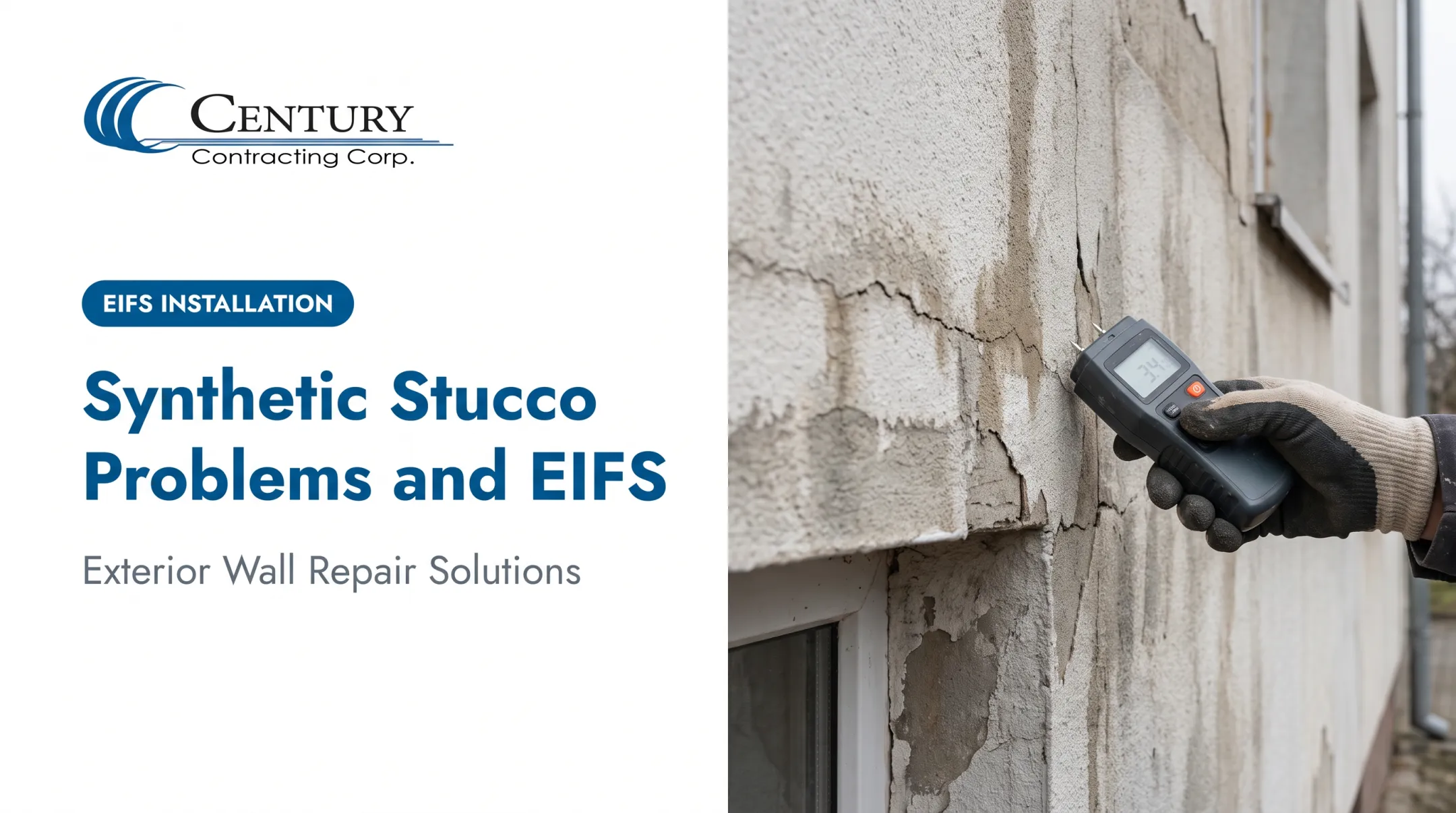
Targeted testing or selective opening-up may follow. Moisture meters give relative screening only, and concealed metal can skew readings. Interpretation takes training.

The Professional Sto EIFS Repair Process
1. Review the Existing System and Site
Before scoping, the contractor gathers plans, specifications, prior repair records, warranty details, maintenance history, and known leak locations. Key site factors include:
- Occupancy and work-hour limits
- Access and scaffolding
- Weather exposure
- Pedestrian protection
- Adjacent materials
- Coordination with the GC or property manager
2. Inspect and Define the Extent
Crews document visible defects, map affected areas, check joints and transitions, and decide whether moisture assessment or selective investigation is warranted. Sto's R100 repair specification defines individual repairs through field inspection and selective demolition. Crews set the boundary by sound material and the likely failure source, not the size of the stain.
3. Remove Failed Materials
Crews remove compromised finish, base coat, mesh, insulation, adhesive, or sealant as needed while protecting surrounding sound EIFS. R100 calls for limiting damage to the substrate during removal.
Coating over wet, loose, or contaminated material hides the problem. It returns, usually sooner and costlier.
4. Correct Moisture and Substrate Issues
Before any new finish goes on, crews fix damaged sheathing, framing, insulation, flashing, water-resistive barrier, and drainage paths. R100 treats structural deficiencies as a separate scope to correct first, and calls for restoring flashing and drainage continuity. Exact work depends on field conditions, project documents, code, and Sto's published details.
5. Rebuild with Compatible Materials
Crews rebuild the system in sequence:
- Prepare the substrate
- Replace insulation and components where needed
- Apply compatible adhesive and base coat
- Embed reinforcing mesh
- Let the base coat cure fully
- Install the matching finish
R100 lists Sto TurboStick for insulation adhesion in localized repairs. It also calls for surface and ambient temperatures above 40°F, expected to hold for 24 hours after application.
6. Match, Seal, and Close Out
Matching texture, color, aggregate, and sheen on weathered commercial facades is hard. R100 calls for a finish mockup. Crews install an approved low-modulus EIFS sealant with the primer the sealant manufacturer requires.
Closeout includes protecting adjacent surfaces, cleanup, punch-list review, repair documentation, owner sign-off, and warranty information. Curing times, temperatures, mixing, and finishing methods follow Sto technical data and the job specification.

Repair, Recoating, Remediation, or Replacement: Choosing the Right Scope
EIMA's restoration bulletin lists five options, from architectural overcoat to remove-and-replace. Here's how they group in practice.
Localized Repair
Suits isolated impact damage, limited cracking, or a failed joint where the surrounding assembly is sound and the cause can be corrected. Sto's guidance allows localized impact repair when opening the wall reveals no substrate or barrier damage.
A small visible defect doesn't guarantee a small repair area. Opening it up often changes the answer.
Recoating and Broader Restoration
Recoating can refresh appearance and renew finish protection when the EIFS, moisture management, and substrate are sound. Before recoating, evaluate:
- Surface preparation and adhesion
- Compatibility, texture, and color
- Manufacturer approval
Sto's field bond strength testing shows whether an existing finish can accept new layers.
Remediation or Replacement
Consider larger-area work when you see:
- Widespread moisture damage
- Recurring leaks
- Failed drainage details
- Extensive delamination
- Deteriorated substrate
- A defect that can't be resolved locally
Weigh long-term risk, disruption, access needs, and lifecycle value against repeated small repairs. Patching every year can cost more than fixing the wall once.
Choosing a Sto EIFS Repair Contractor, Understanding Costs, and Maintaining Repairs
Contractor Qualifications and Sto Experience
Verify:
- Sto training or approval
- Experience with your specific assembly
- Licensing and insurance
- References on commercial buildings
Sto's specification for StoTherm ci asks for three years of similar-system experience and three similar-size projects. Broader credentials help too.
The AWCI EIFSmart seal requires a certified management employee, a certified project foreman, and at least 40% certified field personnel. EIMA membership signals industry involvement but is not applicator certification. Ask to see documentation.
Project Management and Safety
Look for:
- An assigned project manager, superintendent, and foreman
- Clear scheduling and enough workforce
- Occupant protection and trade coordination
Safety questions to ask:
- Is scaffold work led by a trained competent person?
- Is fall protection planned?
- Is staff OSHA 10 trained? (OSHA says Outreach training is voluntary hazard awareness, not a substitute for standards-specific training.)
- Is CPR-certified staff on site?
What Drives Cost
No reliable price range exists for commercial EIFS repair, so be skeptical of any flat figure. Cost moves with:
- Affected square footage and depth of damage
- Substrate, framing, and barrier repairs
- Access and scaffolding
- Testing
- Finish matching
- Sealant replacement
- Weather delays and phasing
- Occupied-building requirements
Get a site-specific assessment and written scope. Then compare proposals for:
- Demolition, substrate repairs, and moisture corrections
- Materials, prep, finish work, and cleanup
- Documentation, exclusions, and change-order procedures
- Warranty terms
Century Contracting Corporation
Century Contracting Corporation is a Mid-Atlantic commercial exterior wall contractor with over 30 years of experience. It is a Sto APW certified contractor, holds certifications with other major EIFS brands, carries a Class A license, and has an AWCI EIFSmart-certified workforce of more than 100 workers.
Each project gets a project manager, superintendent, and foreman. The company has completed more than 3,000 commercial projects and provides a standard two-year installation warranty. Property owners, general contractors, and developers in the Mid-Atlantic can request a project discussion.

Maintenance After Repair
- Follow Sto's maintenance and cleaning guidance
- Inspect sealant joints and transitions regularly (Sto's older guidance calls for regular inspection but sets no fixed interval)
- Keep drainage paths clear
- Inspect after severe weather
- Document new cracks, stains, or surface changes
Power washing is not automatically safe. Test first, stay within Sto's limits, and hire a qualified professional when in doubt.
Frequently Asked Questions
How much does it cost to repair EIFS stucco?
Cost depends on affected area, hidden moisture or substrate damage, access, scaffolding, finish matching, materials, and testing. A site-specific estimate is more reliable than any generic range.
Can you power wash EIFS?
Only with care. Excess pressure, unsuitable cleaners, or poor technique can damage it. Sto's RC100 caps pressure at 500 psi on EIFS and requires testing, so follow current manufacturer guidance or hire a qualified contractor.
What signs indicate that Sto EIFS needs professional repair?
Watch for cracks, bubbling, bulging, soft areas, staining, failed sealants, exposed mesh, recurring leaks, or interior moisture. Any of these warrant a professional assessment.
Can damaged Sto EIFS be repaired without replacing the entire wall?
Often, if damage is isolated. Widespread moisture, deteriorated substrate, failed drainage, or recurring defects may require broader remediation or replacement.
How long does a professional Sto EIFS repair take?
It depends on repair area, access, weather, curing, substrate work, finish matching, and occupancy. Ask for a project-specific schedule.
What should I look for in a Sto EIFS repair contractor?
Look for Sto system knowledge, relevant certifications, commercial experience, licensing, and safety practices. Also require written scopes, strong project management, references, and clear warranty terms.