
Property owners and managers usually have the same four questions when they spot a hole: Is it active? How do I keep birds from coming back? How much moisture damage is hiding behind the opening? And what repair actually fixes it?
This guide walks through identifying the damage, responding safely, repairing the EIFS assembly correctly, deciding between a localized patch and larger restoration, and preventing repeat attacks.
Key Takeaways
- EIFS is often easier to penetrate than hard-coat stucco, drawing woodpeckers for drumming, nesting, or insect foraging.
- Every opening needs documentation and assessment for depth, moisture, mesh damage, and possible nest activity before it's closed.
- Caulk, spray foam, and paint hide a hole — they don't restore the EIFS assembly.
- Localized damage may be repairable; deep, repeated, or moisture-affected damage may call for broader restoration.
- Pair lawful deterrence with system-compatible repair to stop repeat damage.
What Is EIFS, and Why Do Woodpeckers Damage It?
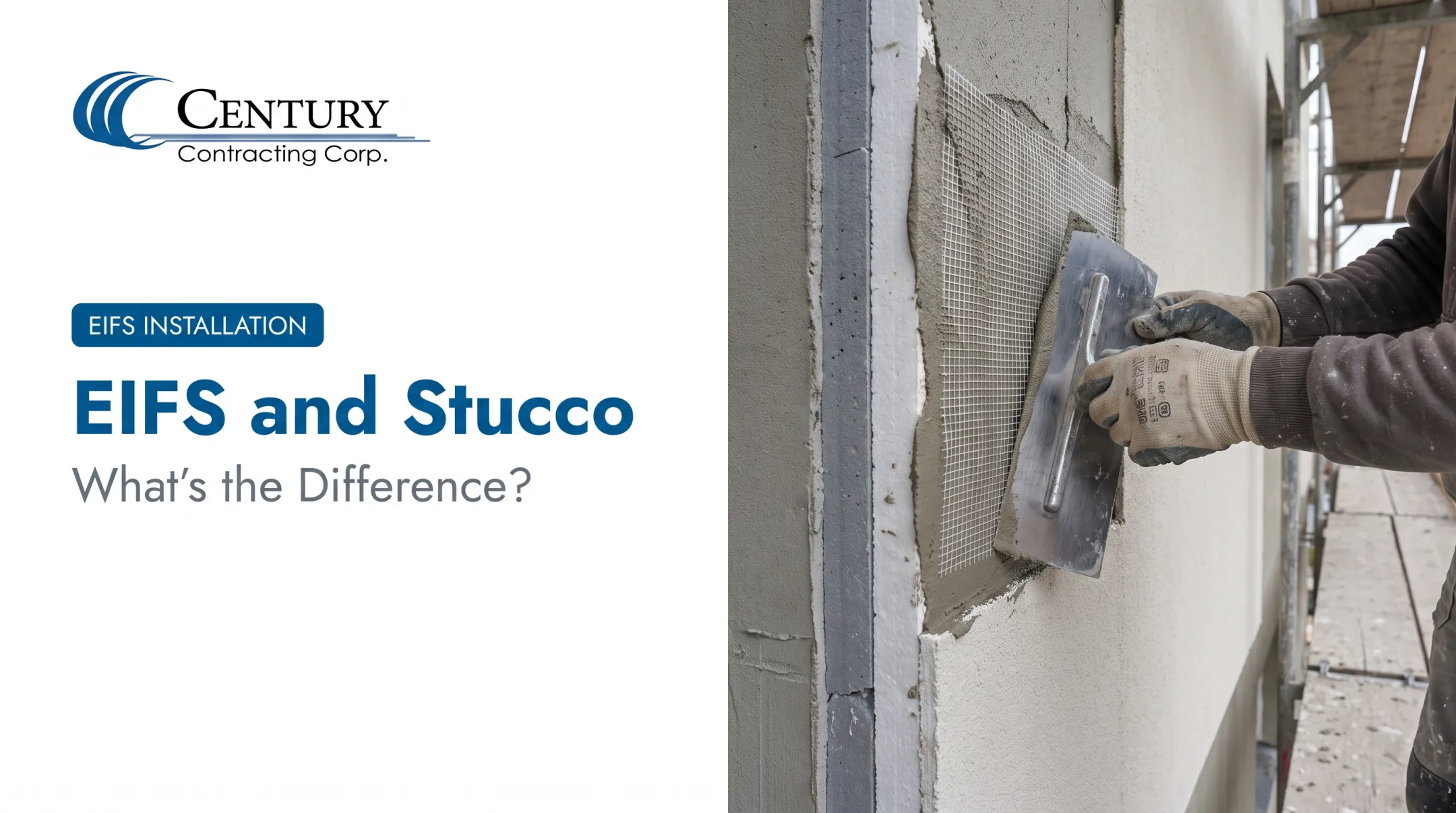
EIFS, short for Exterior Insulation and Finish System, is a layered exterior wall assembly. A typical system with drainage includes:
- A water-resistive barrier and drainage plane
- Insulation board
- Reinforcing mesh embedded in a base coat
- A textured finish coat on top
The exact components vary by manufacturer and project, so specifics should always be confirmed against the original documentation.
That layered structure is what separates EIFS from traditional hard-coat stucco, which is built on cement-based layers over a lath system. The distinction matters for repair.
A surface patch that would work on cement stucco doesn't reconstruct the foam, mesh, and drainage components unique to EIFS. Selecting the wrong repair material — or skipping a moisture check because "it's just stucco" — can leave the underlying assembly compromised.

Why woodpeckers target EIFS
Woodpeckers attack EIFS for a handful of predictable reasons:
- Territorial drumming on a surface that produces a resonant sound during mating season or territory defense
- Foraging for insects or larvae associated with moisture, decay, or concealed activity inside the wall
- Excavating a nesting cavity, or returning to reopen a hole used in a previous season
- Targeting shaded, secluded, or elevated details such as eaves, ledges, trim, and roofline transitions
A 2025 Montana Department of Agriculture guide notes that woodpeckers can penetrate EIFS surfaces and excavate the foam beneath fairly quickly once they break through the finish. That's exactly why a small hole shouldn't be assumed to be shallow.
Common Woodpecker Damage to EIFS and Why It Happens
The visible hole is only part of the story. Damage severity depends on how far the bird got, and that isn't always obvious from the surface.
What the damage typically looks like
Common patterns include:
- Small, shallow punctures from testing or drumming
- Chipped or cracked finish coat without deeper penetration
- Larger cavities with exposed insulation
- Torn or exposed reinforcing mesh
- Loose, delaminated sections around the hole
Surface size alone doesn't tell you how deep the damage goes. A small opening can conceal a much larger excavated cavity behind it. Watch for these signs of concealed damage:
- Staining or bubbling around the hole
- Soft or spongy areas when pressed
- Cracks radiating outward from the opening
- Interior moisture stains on the opposite side of the wall
- Damage that keeps recurring at the same spot
Exposed insulation and open cavities invite rainwater, insects, debris, and repeat nesting. Left open, they can expand the eventual repair scope.
Root causes worth documenting
Recurring attacks usually trace back to drumming, nesting, or insect activity. Before repairing anything, note the location, season, nearby vegetation, and any visible insect or decay evidence.
Aging or vulnerable details can make an elevation easier to attack: exposed foam edges, failed sealants, damaged trim, or poorly protected transitions. That said, don't assume an installation defect without a proper inspection first.
Species vary by region. The U.S. Fish and Wildlife Service notes that red-bellied and pileated woodpeckers are common across much of the eastern United States, with northern flickers found nearly nationwide. All native woodpeckers are protected under the Migratory Bird Treaty Act. Trapping, nest destruction, or lethal control are not appropriate responses, regardless of how much damage has occurred.
How to Respond to Woodpecker Damage to EIFS
The first response should protect both the building and the birds while preserving the information needed to determine the right repair.
Step 1: Check for an active nest before closing anything
Look for birds, eggs, or dependent young before you seal, fill, or disturb the opening in any way. The U.S. Fish and Wildlife Service's nest guidance makes clear that destroying an active nest containing eggs or chicks requires a permit, and disturbing dependent young can constitute unlawful take.
If there's any doubt, contact a qualified wildlife professional or your state wildlife agency before proceeding.
Step 2: Document and temporarily protect the damage
Photograph every hole from multiple angles. Record location, approximate size, and whether multiple elevations show activity.
If temporary protection from rain is needed, use a breathable, removable cover rather than a permanent patch: one that won't trap moisture or seal in an active nest. Skip climbing or working at height without proper equipment and training.
Step 3: Inspect the surrounding EIFS assembly
A qualified inspector should evaluate:
- Finish and base coat: condition around the opening
- Reinforcing mesh: tears or displacement
- Insulation board: saturation or crumbling
- Drainage and water-resistive layers: condition behind the insulation
- Substrate, flashing, sealants, and nearby penetrations: damage or gaps
Non-destructive checks come first. Moisture testing or a limited exploratory opening may be necessary if staining or softness suggests hidden water intrusion.
Step 4: Remove compromised materials and rebuild the layers
A proper repair typically follows this sequence:
- Remove loose or damaged finish and insulation
- Address any wet or deteriorated substrate
- Replace insulation with a compatible product
- Integrate new mesh and base coat with the existing system
- Finish with a matched coat
System compatibility matters. Manufacturer instructions, color and texture matching, curing conditions, and proper edge detailing all affect whether the repair restores the wall's performance.
Step 5: Test and document the completed repair
Once finished, check the area for:
- Secure adhesion
- Continuous weather protection
- Working drainage paths
- Proper sealants
- Finish uniformity
Keep records of materials used, affected locations, photos, suspected attractants, and a follow-up monitoring plan for future maintenance.

Fix vs Replace EIFS and Prevent Future Woodpecker Damage
Deciding between a patch and a larger restoration comes down to damage depth, moisture risk, appearance, access, recurrence, and the condition of the surrounding EIFS, not just how many holes you count.
When localized repair may be appropriate
A targeted repair can work when:
- Damage is isolated to a single, small area
- Surrounding mesh and insulation remain sound
- There's no meaningful moisture or substrate deterioration
- The finish can be blended in acceptably
An EIFS professional, not a homeowner with a tube of caulk, should confirm the repair actually reconnects the system's protective layers rather than just covering the hole.
When broader restoration makes more sense
Consider larger-scope work when you see:
- Deep or numerous cavities across an elevation
- Widespread delamination
- Wet or deteriorated sheathing
- Recurring attacks at multiple spots
- Inaccessible areas requiring lift equipment anyway
- Noticeable finish mismatch after patching
Full-wall replacement isn't automatic just because damage is extensive, but a larger restoration often delivers better moisture control and appearance than a patchwork of isolated repairs.
Deterrence that won't compromise the wall
Physical exclusion tends to outperform visual scare tactics. The USFWS notes that taut, well-maintained bird netting is typically effective. Moving or reflective devices produce inconsistent results, and stationary decoys usually stop working within days.
Whatever deterrent you choose:
- Avoid damaging the finish or trapping moisture
- Keep drainage paths and maintenance access clear
- Install only after confirming wildlife-law requirements
Repairing nearby attractants such as insect activity, deteriorated trim, exposed edges, and moisture problems reduces the incentive to return. Follow up with regular perimeter checks.

Mistakes worth avoiding
- Filling a hole with spray foam, caulk, or paint and assuming the assembly is restored
- Closing an opening before confirming there's no active nest
- Starting a repair without confirming whether the wall is EIFS or traditional stucco
- Using incompatible materials or ignoring moisture found behind the hole
- Relying on a single scare device indefinitely with no monitoring
Century Contracting Corporation regularly evaluates whether a damaged section can be patched to manufacturer spec or needs a wider recoat on commercial buildings throughout the Mid-Atlantic.
Conclusion
Woodpecker damage to EIFS is a building-envelope issue first and a bird nuisance second. Treating it as cosmetic, a quick caulk job and some netting, skips the steps that actually protect the wall.
The sequence holds up regardless of building size:
- Check for an active nest
- Document the damage
- Inspect the full assembly
- Perform a compatible repair
- Pair restoration with lawful deterrence
For commercial property owners and managers, Century Contracting Corporation offers EIFS and stucco assessment and repair. Work is backed by an AWCI EIFSmart-certified workforce, Dryvit, STO, Senergy, and Parex certifications, and experienced project management on jobs from small patch repairs to full elevation restoration.
Confirm project-specific scope and warranty terms directly with the team before work begins.
Frequently Asked Questions
Will homeowners insurance pay for woodpecker damage to EIFS?
Coverage depends on your policy, how the cause is classified, exclusions, and your deductible. Water damage from the holes is sometimes treated differently than the bird damage itself. Review your policy and contact your insurer rather than assuming coverage.
How do I stop woodpeckers from damaging EIFS?
Pair a prompt, system-compatible repair with nest-season precautions, remove attractants such as insects or exposed trim, and install physical deterrents like taut netting. No single method guarantees results, so keep monitoring the wall.
How much does it cost to repair EIFS woodpecker damage?
Pricing varies with hole size and depth, moisture or substrate damage, access needs, and finish matching. Angi's 2026 EIFS repair guide cites $300 to $500 for a small, roughly 10-square-foot patch as a homeowner benchmark. Get a site-specific quote for larger or commercial repairs.
Can you fill a woodpecker hole in EIFS with spray foam?
Spray foam alone doesn't restore the reinforcing mesh, base coat, finish, or drainage performance of the EIFS assembly. It may temporarily block the opening but leaves the wall's moisture-control system incomplete. Get an EIFS-specific assessment before choosing a repair method.
Does woodpecker damage mean the entire EIFS wall needs to be replaced?
Not necessarily. Isolated damage with sound surrounding materials can often be repaired locally. Widespread penetration, trapped moisture, substrate deterioration, or recurring attacks across an elevation typically justify broader removal or replacement.